
While dog body language can be more obvious, cats tend to be more subtle. There are other factors to consider when it comes to cats too.
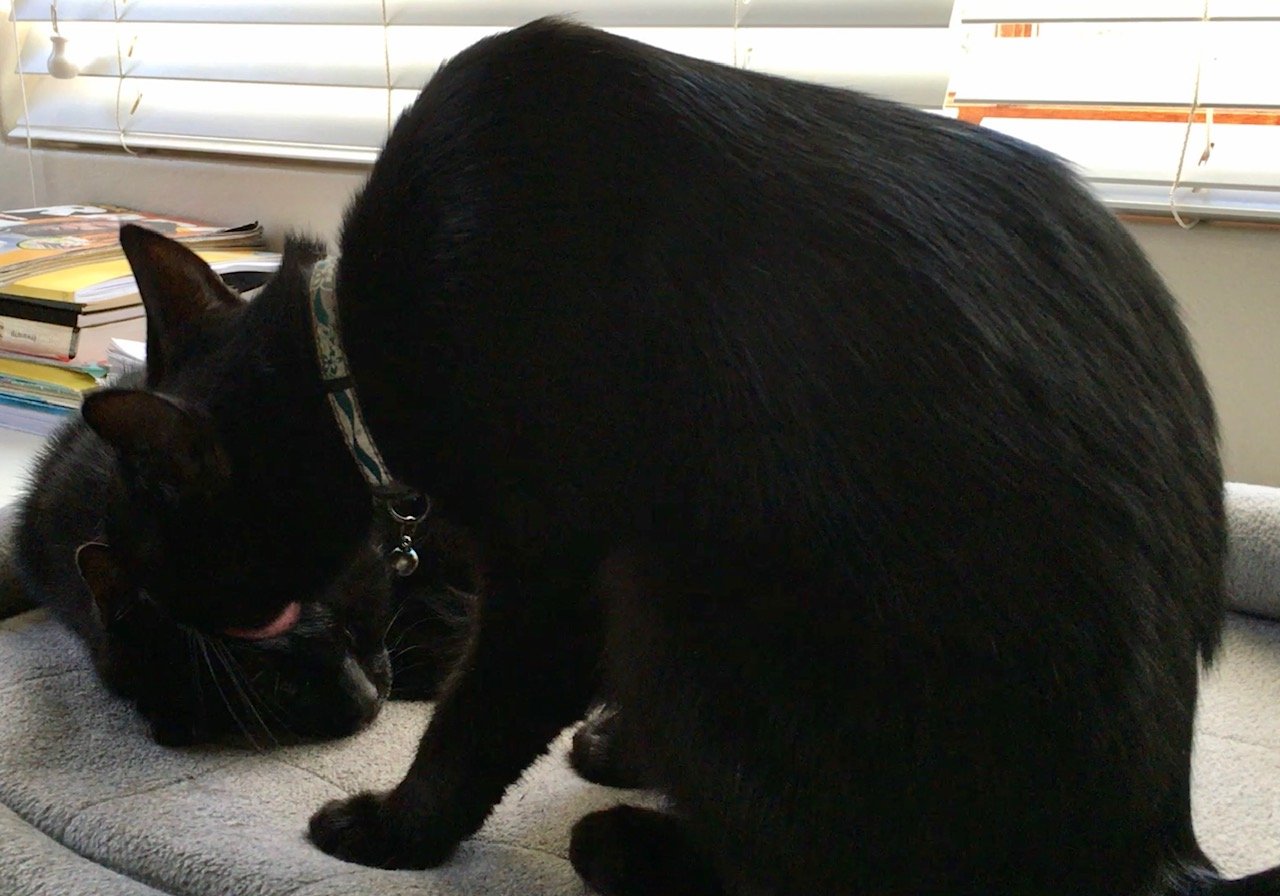
Grooming as a way to say ‘please stay’, or ‘hey!’
Are we smarter with dogs?
With dogs we know that waggy tails won't always mean one thing. The height (compared to normal), stiffness and speed of a tail wag can mean that the dog is experiencing different feelings from tension to happiness, excitement or apprehension.
Myths
Many myths still abound around cats, and these can impact the way people ‘read’ their cat’s behaviour. For example, when a cat looks away from something, this could be seen as a cat being nonchalant or not bothered, where in fact it can be a subtle signal aimed at avoiding conflict.
What we’d love to believe
With slow blinking, this can reflect cat happiness and contentment. And we blink back too sometimes. But squinty eyes can also be a sign the cat is increasingly concerned or focused on something. Or there may be pain or other medical conditions involved with blinking and squinting. It reminds us that it's important to always consider the big picture when trying to read body language. And not to be thrown off by what we'd like to think.
What we ‘know’
On the topic of one cat grooming another. This might well be a sign of closeness between two cats, or it might be a gentle way to avoid social tension. This was highlighted in a new study by Van Belle and colleagues (2026).
Looking closer
When we think about reading body language, we can remember to:
Consider the individual animal’s point of view (without bringing in complicated human explanations).
Think about all that we’re seeing, in context, versus what we’d like to believe.
Take new evidence into account.
New research continues to build our understanding of how animals communicate with each other and with us. Greater understanding helps us build a stronger bond.
Van Belle, M. J. R., Moons, C. P. H., Mills, D. S., Broeckx, B. J. G., Tuyttens, F. A. M., & Gajdoš Kmecová, N. (2026). Unravelling Feline Social Dynamics - a video-based observational study on allogrooming in domestic cats. Applied Animal Behaviour Science, 301, 107038.